Adolescents are developmentally more vulnerable to risk behavior engagement. And the behaviors we experiment with and engage in during this stage are likely to remain with us into adulthood. This means the more we can encourage healthy behaviors now, the more likely they will persist later.
Key questions related to substance use prevention are:
- How effective are evidence-based substance use prevention efforts in contexts of legalized cannabis?
- How effective are youth participatory action research approaches for substance use prevention?
- Is program delivery in an online setting as effective as in-person?

Related Projects
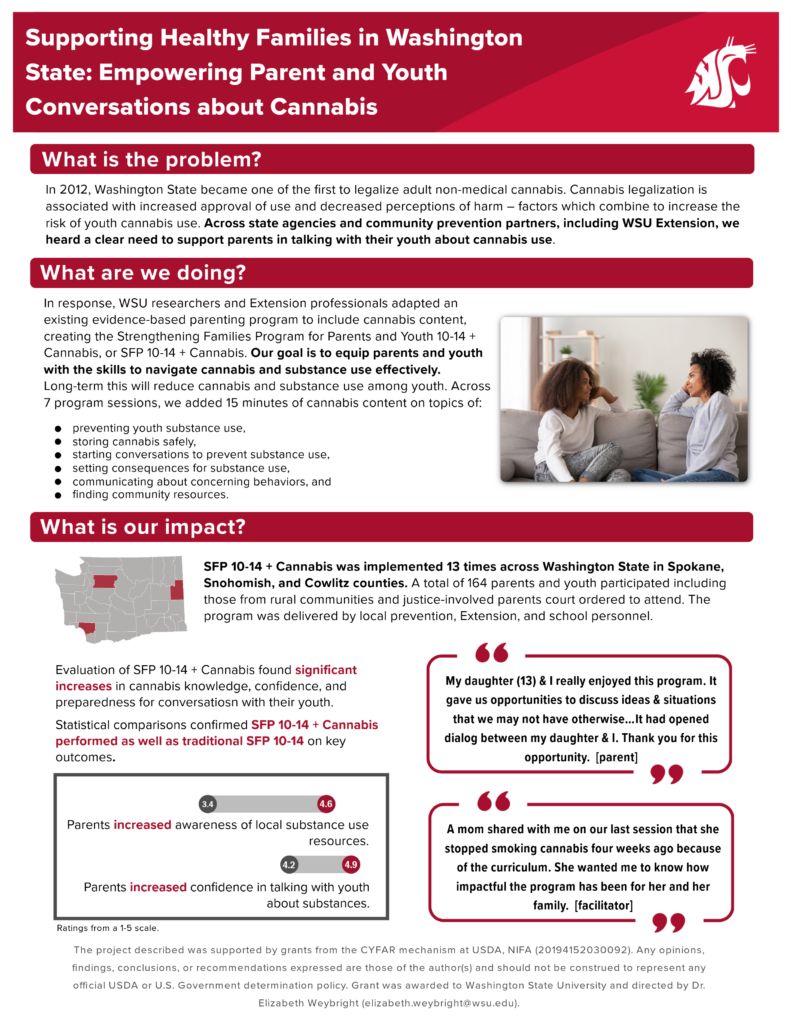
Adapting Strengthening Families Program 10-14 for a Context of Legalized Cannabis
In efforts funded by SAMHSA and USDA, we adapted Strengthening Families Program 10-14 (SFP 10-14) in two ways. One for implementation in a legalized cannabis context and another to deliver the program in a virtual format.
Available resources include:
- A virtual toolkit for implementing SFP 10-14 online and publication of the virtual adaptation process and outcomes in the Global Implementation Research and Applications journal.
- A toolkit and marketing plan for delivering SFP 10-14 + Cannabis, our cannabis adaptation of SFP 10-14.
- An impact report for SFP 10-14 + Cannabis.
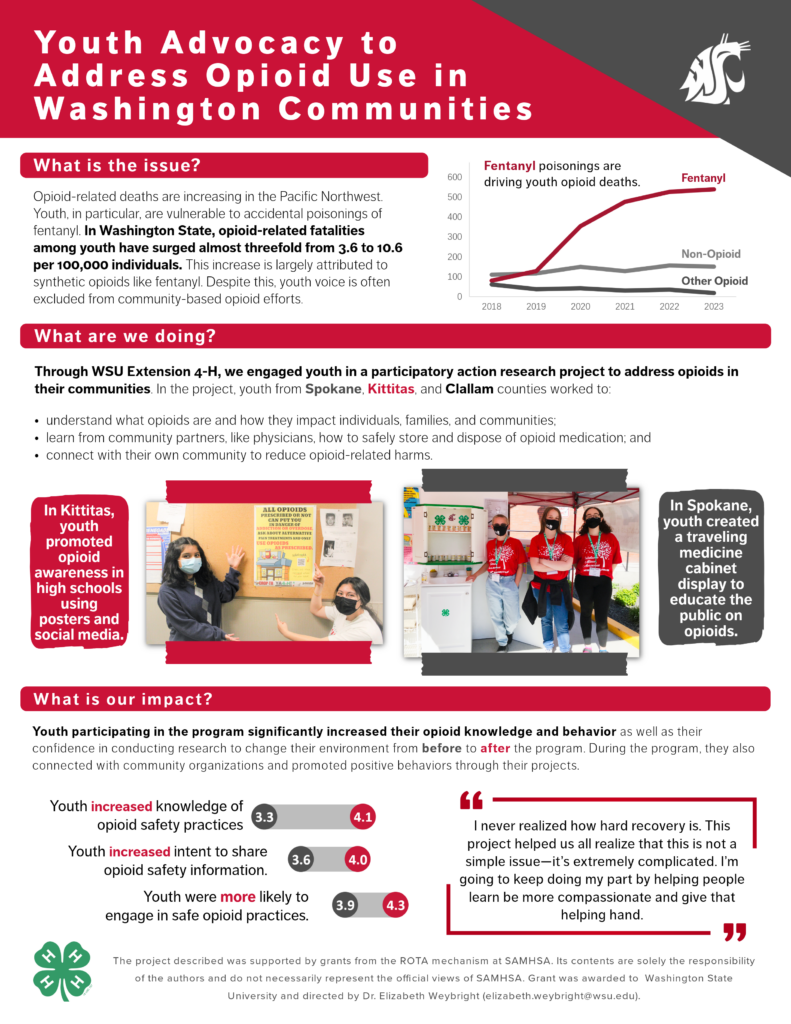
Youth Engagement for Substance Use Prevention
Funded by SAMHSA and Washington State Health Care Authority, we implemented youth participatory action research (YPAR) projects in key communities across the state and provided training for prevention and other professionals for youth engagement. We have also provided trainings on youth engagement for Washington State SNAP-Ed and Arizona HealthZone.
You can see YPAR youth in action in the following media stories:
- Teens lead prevention efforts surrounding rural opioid addiction
- Fox28, Spokane, WA coverage
- KHQ, Spokane, WA coverage
- Clallam County 4-H page
- Sequim Gazette coverage
Available resources include:
- A Youth Engagement Resource Guide outlining types of youth engagement and examples.
- An introductory webinar on YPAR.
- An impact report for YPAR research findings.